Cartesian Impedance Control for Franka Panda
Null-space projected Cartesian impedance controller for a 7-DOF Franka Panda, simulated in MuJoCo with Pinocchio for kinematics/dynamics
What it is
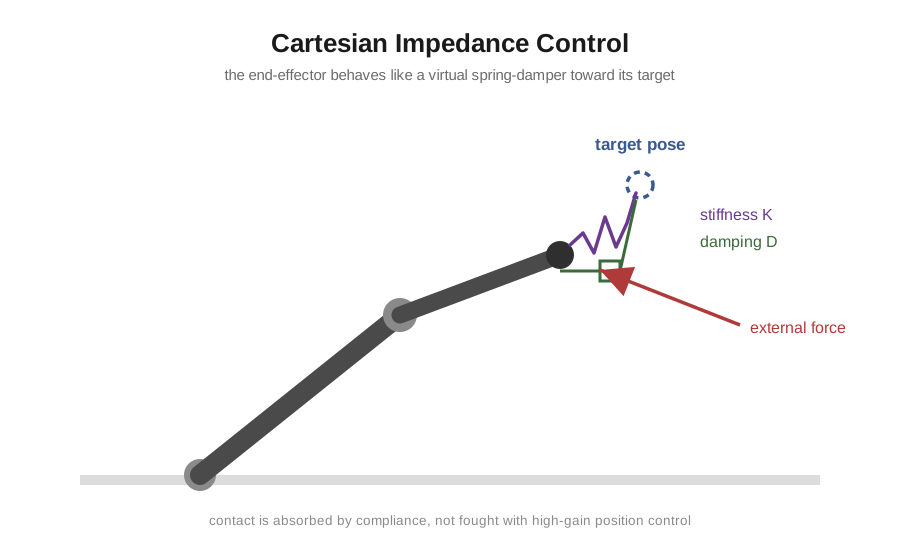
A Cartesian impedance controller for a 7-DOF Franka Emika Panda, simulated in MuJoCo with Pinocchio handling the kinematics and rigid-body dynamics. Rather than commanding joint positions directly, the controller makes the end-effector behave like a virtual spring-damper toward a target pose — letting the arm comply with unexpected contact instead of fighting it, which matters for any task where contact is expected (as opposed to purely free-space motion).
How it works
- At each control step, Pinocchio computes the end-effector Jacobian and the current Cartesian pose/velocity from the robot’s joint state.
- Desired joint torques are computed from the Cartesian pose and velocity error against a target pose, through a stiffness/damping law mapped back into joint space via the Jacobian transpose.
- Because the Panda has 7 joints for a 6-DOF Cartesian task, there’s one redundant degree of freedom — a null-space projection term adds secondary damping in that redundant direction, so the arm doesn’t drift or oscillate in ways that don’t affect the end-effector pose.
- Torques are applied directly as MuJoCo actuator commands, closing the loop in simulation.

Scenarios
The repo evaluates three configurations — Stiff & Critically Damped, Low-Stiffness & Critically Damped, and Low-Stiffness & Underdamped — across three tasks:
- Free-space: tracking a Cartesian trajectory with nothing in the way.
- Wall-contact: tracking the same trajectory into a rigid obstacle, where a stiffer controller pushes harder against the wall while a compliant one yields.
- Disturbance: an external push mid-trajectory, testing how each configuration recovers.
The estimated external force plots (rightmost column above) come directly from the tracking-error term in the impedance law, without any force/torque sensor — a compliant controller effectively gives you a rough contact-force estimate for free.