Chaos-Aware Sensitivity Analysis of RL Policies
Using Finite-Time Lyapunov Exponents to analyze the sensitivity of SAC/PPO policies trained on a sparse-reward pendulum swing-up task
What it is
A study of how sensitive a trained RL policy’s closed-loop behavior is to small changes in initial conditions, using a sparse-reward pendulum swing-up task — the policy only gets a reward if it ends the episode upright and nearly still, with no shaping reward along the way, which makes the control problem noticeably harder than the standard dense-reward version. I trained both SAC and PPO agents (via Stable-Baselines3) on this task and then asked: near which states does the trained policy’s closed-loop behavior become unpredictable under tiny perturbations?
How it works
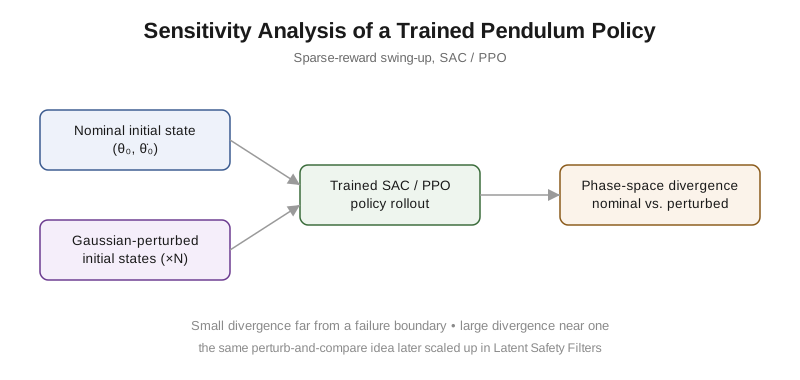
- Roll out the trained policy from a nominal initial state (a starting angle and angular velocity), recording the full trajectory.
- Perturb that initial state with Gaussian noise, independently on angle and angular velocity, and roll out the same policy from each perturbed start.
- Compare the perturbed trajectories against the nominal one in phase space (angle vs. angular velocity): if they track closely, the policy is locally stable there; if they fan out into very different outcomes, that state is close to a boundary between success and failure.
- Repeat across many initial states to build up a picture of where the trained policy’s basin of attraction is fragile versus robust, for both SAC and PPO.
Why it matters
This was an early, low-cost testbed for an idea that turned out to generalize much further: treating trajectory divergence under small perturbations as a label-free signal for approaching failure, without needing any hand-labelled failure data. That same perturb-and-compare mechanism is the core of the Latent Safety Filters safety monitor I later built for real robot manipulation — the pendulum version made it cheap to iterate on the idea before scaling it up to a learned visual world model and a real Franka Panda.