Diffusion Policy for Real-Robot Manipulation
Adapting Diffusion Policy to dual-camera Franka Panda manipulation, with a real-time serving architecture for closed-loop control
What it is
Diffusion Policy (Chi et al., RSS 2023) frames visuomotor robot control as a conditional denoising process: instead of regressing directly to a single action, the policy learns to iteratively denoise a randomly-initialized action sequence conditioned on the current observation. That lets it represent the multimodal, discontinuous action distributions that show up constantly in contact-rich manipulation (e.g. “grasp from the left or the right, both are fine”) far better than a standard behavior-cloning regression head.
I forked the original Columbia/real-stanford codebase — built and benchmarked around simulated tasks like PushT — to train and deploy it on our lab’s Franka Panda arm for a real, contact-rich pick-and-place task.
How it works
- Human teleoperation demonstrations (collected via the VR teleop pipeline in VR Teleop Data Collection) are converted into the Zarr dataset format the training pipeline expects.
- A U-Net-based diffusion model is trained to denoise short action-sequence “chunks,” conditioned on a short history of visual + proprioceptive observations.
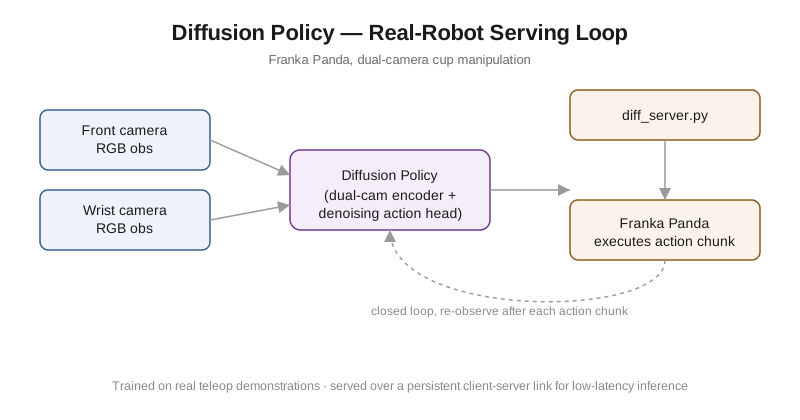
- At inference, the model runs the reverse diffusion process to sample an action chunk, executes part of it on the robot, then re-observes and re-plans — the same receding-horizon idea as MPC, but with a diffusion model instead of an optimizer in the loop.
In action
My contributions
Starting from a codebase built for single-camera simulated benchmarks, I adapted it for a real dual-camera manipulation task end-to-end:
- New real-world task: added a “franka cup” task — dataset loader, image-based task config, and training config for a custom cup manipulation demonstration set collected on the physical arm (
cup_dataset.py,train_franka_cup.yaml). - Dual-camera perception: extended the single-view pipeline to a front + wrist camera setup, including a new Zarr conversion script and dataset class for the two-camera data (
create_dual_zarr_proc.py,cup_dual_dataset.py/cup_dual_dataset_proc.py). - Real-robot inference: since the original repo only evaluates in simulated gym environments, I wrote a
inference.pyscript plus a “dummy” env runner (dummy_runner.py,eval_dummy.py) so the trained policy could be rolled out and evaluated directly on hardware instead of in a simulator. - Model serving: built
diff_server.py/diff_server_dual.py, a lightweight client-server layer that hosts the trained policy on a GPU machine and serves action predictions to the robot’s control loop in real time, decoupling training/inference hardware from the robot’s control computer.
Code
The full fork, including the dual-camera task configs, real-robot inference scripts, and serving code described above, is available on GitHub: